

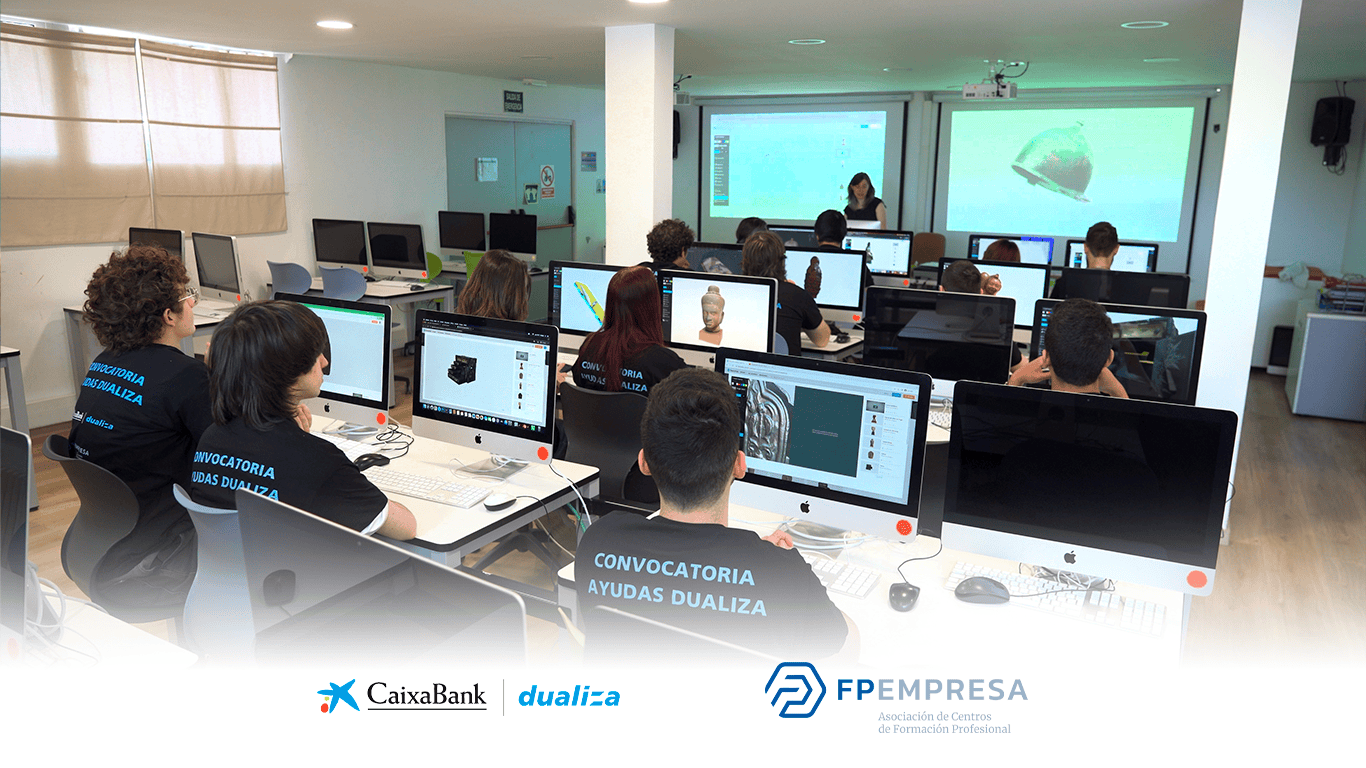
Vocational Education and Training (VET) students developing digital projects as part of the Dualiza Grants Call during a hands-on session in a technology classroom.
- The call will support the development of 38 VET projects with €463,681, the highest amount awarded across its nine editions.
- The projects will involve 2,860 students, 279 teachers and 70 partner organisations, with 58 VET centres receiving financial support.
- Applied artificial intelligence in healthcare, environmental monitoring, renewable energy, accessibility, advanced cosmetics and agricultural digitalisation are among the emerging trends featured in this edition.
- Ten of the selected projects are network-based initiatives, strengthening cooperation between centres from different provinces and autonomous communities.
The 9th Dualiza Grants Call, promoted by CaixaBank Dualiza and the Association of Vocational Education and Training Centres FPEmpresa, has selected the 38 most innovative VET projects in Spain, which will receive financial support to be developed during the 2025–2026 academic year. This edition thus becomes the one that funds the highest number of initiatives and distributes the largest volume of funding in the history of the programme.
The projects have been promoted by 38 leading centres, together with 20 additional applicant centres, bringing the total number of financially supported VET centres to 58—eight more than in the previous year. Overall, the selected initiatives involve 2,860 students, including 108 enrolled in Intensive Dual VET, and 279 teachers, reinforcing the role of VET as a generator of applied knowledge and solutions to real challenges within the productive environment.
Trends: AI applied to healthcare, agricultural monitoring, sustainability and high social-impact projects
The thematic diversity of the call once again stands out as one of its defining features, with projects reflecting both labour market needs and global challenges related to sustainability, healthcare and digitalisation.
Artificial Intelligence and immersive technologies
- AI systems to detect errors in patient positioning for radiographic imaging.
- Mobile applications that transform the robotic voice of an electrolarynx into a personalised natural voice using AI.
- Immersive cycling routes using virtual reality and interactive training systems.
- Advanced digital tools for managing work placements and competency-based assessment.
- 3D environments generated through Gaussian Splatting applied to student projects.
Digital health, biotechnology and advanced analytical techniques
- Comparative testing of nanodrugs in breast cancer cell lines.
- Advanced microbiology projects and phage therapy as an alternative to antibiotics.
- Specialised training in spectrophotometry, ELISA and Western blotting.
- Mobile applications promoting the safe use of medicines and healthy habits.
Smart agriculture and environmental monitoring
- Agroclimatic sensor networks and environmental probes.
- Drone-based monitoring of apple snail populations and salinity levels in the Ebro Delta.
- Comparative studies of organic and biodynamic crops and nutritional analysis of local varieties.
- Mobile solar greenhouses using photovoltaic glass and automated control systems.
Renewable energy, efficiency and home automation
- Solar-powered vending machines with digital monitoring.
- Sustainable insulation designs using wool.
- Improved building energy efficiency through ETICS (External Thermal Insulation Composite Systems).
- Automated flood control systems.
Inclusion, accessibility and culture
- Inclusive tools enabling visually impaired people to access dance performances.
- Games, sports equipment and adapted materials for older people or those with reduced mobility.
- Documentary projects exploring the reality of Roma communities.
- Illustrated poetry collections and cultural projects fully developed by students.
SME digitalisation and the creative economy
- Simulated digital marketing agencies providing services to local businesses.
- Design and manufacture of optimised components for competitive bicycles.
- Construction prototypes, electric care vehicles and solutions incorporating biomedical sensors.
Overall, the selected projects span a wide range of professional families, with a particularly strong presence this year in Healthcare, Agriculture, Electricity and Electronics, IT and Chemistry, aligning with emerging sectors and the priorities set out in the new VET Law.
Among the 38 selected projects, 10 are collaborative network-based initiatives, jointly developed by several educational centres, strengthening interregional cooperation and knowledge transfer across communities. In addition, the projects involve 70 partner organisations—including companies, associations, local authorities and social organisations—consolidating a stable ecosystem of partnerships that connects VET with the real needs of the productive sector.
In the selection process, the evaluation committee placed particular emphasis on the innovative and applicable nature of the proposals, their transferability, the diversity of stakeholders involved and their social impact, as well as their alignment with the Sustainable Development Goals, with a strong presence of SDGs 4, 9 and 12. Long-term sustainability and the quality of the work plan were also taken into account.
In this context, the Director of CaixaBank Dualiza, Paula San Luis, highlighted how the call “consolidates an innovation ecosystem in VET that generates real value for students, centres and companies, demonstrating the capacity and commitment of teachers to address labour market challenges from a modern, inclusive and connected perspective.”
For his part, the President of FPEmpresa, Luis García, underlined that this edition reinforces “the extraordinary commitment of teachers, who are capable of driving projects that combine innovation, social usefulness and collaboration with companies at a time of full implementation of the new VET system.”
The Dualiza Grants Call is thus consolidated as one of the main drivers of innovation in Vocational Education and Training in Spain. Across its nine editions, it has supported more than 300 educational initiatives, distributing nearly €3.5 million to make them possible across all autonomous communities. The full list of selected projects is available at www.caixabankdualiza.es
Author: The Association of Vocational Training Centres, FPEmpresa, Communications Team (Institutional publication)