
Can virtual reality transform the way we prepare learners for ethical challenges in care? The VRCare pilots show that it can.
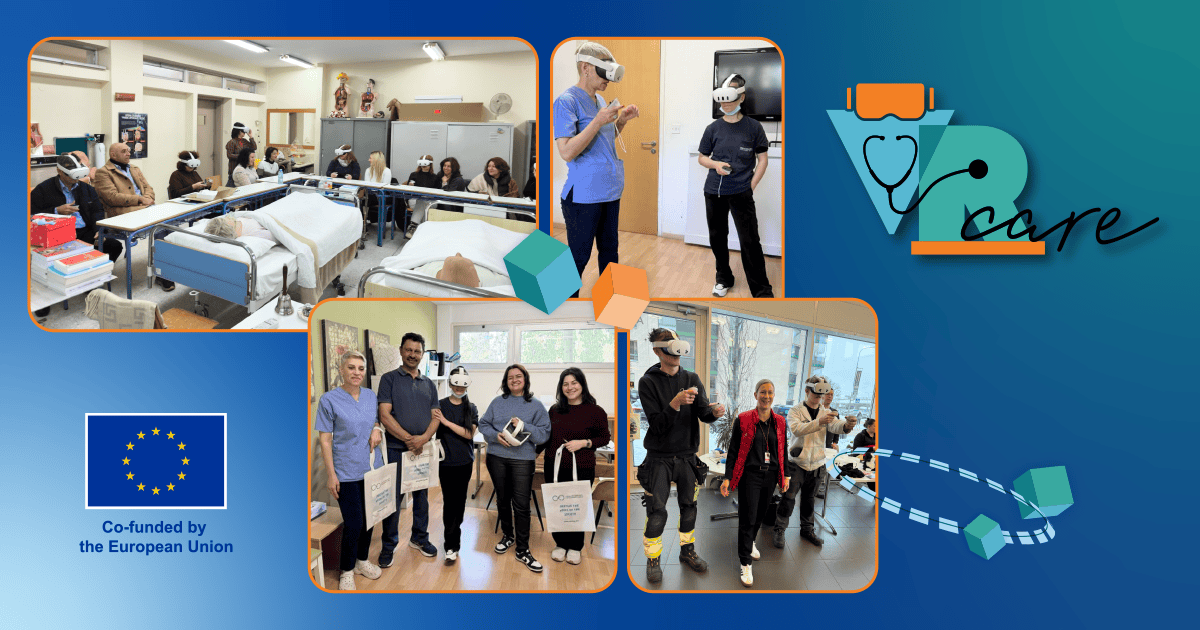
At the heart of this experience is VRCare, an Erasmus+ KA220 project co-funded by the European Union through the Finnish National Agency EDUFI. During the pilot phase, 235 participants from Finland, Denmark, Ireland, Spain, Greece, and Cyprus explored how virtual reality can support learning in childcare and elderly care. For many, this was their first experience using VR.
Participants entered realistic care scenarios and engaged with ethical dilemmas in ways that felt immediate and authentic. Instead of only discussing difficult situations in theory, they were able to practise decision-making, communication, and reflection in a safe environment. This helped them build confidence, strengthen practical skills, and deepen their understanding of complex care situations.
The pilots also confirmed the importance of collaboration. Students, teachers, and healthcare practitioners all played a role in testing and improving the scenarios.
VRCare shows that immersive learning can be accessible, engaging, and highly relevant for education and training in the care sector.
Author: Eugenia Anastassopoulou, EU project manager at p-consulting.gr
Project’s Website: https://vrcare-project.eu/
Project’s facebook: https://www.facebook.com/vrcareproject
Project’s Instagram: https://www.instagram.com/vrcareproject/
Project’s LinkedIn: https://www.linkedin.com/company/vrcare-project/