

As the 40th anniversary of Erasmus was approaching, Scuola Centrale Formazione (SCF) brought together mobility professionals, vocational schools and young talent in Milan for the 14th edition of Do Your MOB. The theme, ‘Learning Citizenship through Mobility’, treated citizenship not as a set of rights or theoretical knowledge, but as something learned through encounter, participation, and experience. The event also saw the launch of the inaugural SCF Skills Competition, an international championship for vocational students.
On the first day, which took place at the Fondazione Luigi Clerici, Francesca Drago of the Scuola Centrale Formazione opened the event by delivering two keynote speeches on the importance of bringing together knowledge, experience and practice through the ‘Learning Citizenship through Mobility’ community. Anna Barbieri, from the European Commission’s Directorate-General for Employment, Social Affairs and Inclusion, discussed the future of transnational mobility within the Erasmus programme for the period 2028–2034. Valentina Chanina, Secretary General of EfVET, then gave a talk entitled ‘Citizenship and Networks: Essential Links for Global Skills’.
Anna Barbieri stressed that citizenship is a core part of Erasmus+, referring to the ability to act responsibly in civic and social life at all levels, including the European level. The importance of citizenship is growing: citizenship competences are now explicitly included in the Capacity Building action, opening cooperation up to organisations in third countries. She referred to the programme’s interim evaluation, in which approximately 90% of participants stated that learning mobility had strengthened their sense of European identity and their appreciation of European values. Looking ahead, she explained that the Commission’s proposal for the next funding period prioritises learning mobility and enables it to encompass learning about European integration, values and citizenship. She urged the audience to seize these opportunities and develop citizenship competencies in a structured way, both abroad and at home. Regarding the global dimension, she mentioned that negotiations are ongoing and encouraged participants to inform their national representatives of the importance of mobility beyond Europe, as budgets are currently being decided.
In her speech, Valentina Chanina underlined that this year, EfVET’s focus has been on global citizenship. The theme of the 2026 Annual Conference in Brussels was ‘Global Citizenship Empowered by VET’, and it was argued that VET reaches beyond employability. Learners also require values, agency and resilience in order to participate in their communities and in a globalised world. This idea is also central to the Youth Forum, now in its third year, in which over 30 students from across Europe presented their own declaration to policymakers. This idea is also reflected in ‘The Hands that Built Europe’, a new cultural initiative celebrating the people who shaped vocational learning. Policy and advocacy have been a second priority. EfVET has engaged its members and its Policy Working Group in responding to Commission consultations, including the Education Package. The organisation has collaborated with its sister organisations, EVBB and EVTA, as well as partners in VET4EU2, to develop the Herning Declaration. Thematic teams, such as those focusing on internationalisation and learning mobility, provide members with a platform to share best practice and influence the upcoming discussion on the new European VET Strategy.
Four workshops followed, two in the morning and two in the afternoon:
- Approaches for promoting democratic citizenship in VET (Andreas Gabriel and Ludger Dieckmann)
- Virtual exchange in vocational training and critical thinking in the age of AI (Sara Pittarello, UNICollaboration)
- Global citizenship in skills competitions (Alma Skroeli, Albanian Skills)
- European citizenship: the “Europe and Me” initiative (Florence Delseny, ALFMED)
At the closing session, the groups shared their findings. The democratic citizenship group concluded that learners, teachers and trainers need stronger knowledge of history, democracy and different cultures. They also noted the difficulty of balancing job-specific content with broader civic topics. Their conclusion was that VET institutions are often the last chance to reach students before working life and must use it, ideally through systemic solutions that reach many students rather than one-off initiatives.
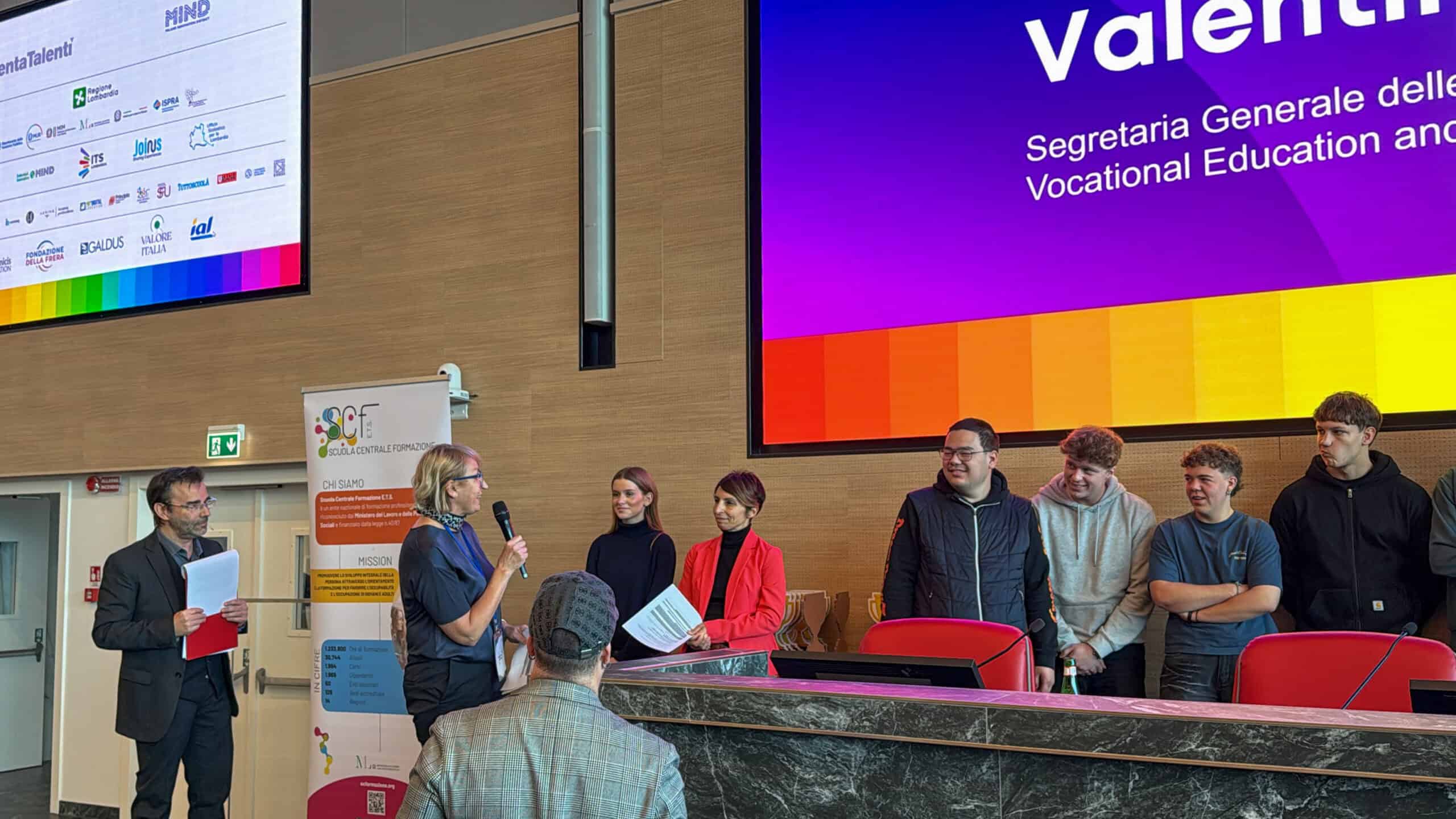
On the second day, the event on 5 November closed at the MIND Innovation District with the ‘Prospettiva Futuro: Skill Competition Award 2026’ ceremony. The programme included a keynote speech by Rosy Russo of Parole O_Stili, awards in five categories, and presentations of the ‘Io Sono Futuro 2026’ projects from New York. The conclusions were given by Paolo Cesana, Vice President of SCF, and Simona Tironi, Lombardy Region Assessor for Vocational Education and Training.
Valentina Chanina, EfVET Secretary General, awarded the prizes in the automotive sector. The winners were Team ZBC from Denmark, with Institut Narcís Monturiol from Figueres, Spain, taking second place. Third place was shared by Fondazione Luigi Clerici and Institut Andreu Nin from El Vendrell, Spain.
The EfVET Secretary General praised the Danish team for their passion and dedication to their studies, as well as their professionalism, which was already evident due to their experience of working in the real environment. She highlighted their technical and communication skills, and, above all, their teamwork. Each member gave their all for a shared goal, combining talent, preparation, and collaboration. The winners will receive an Erasmus+ scholarship to undertake training abroad.
The two-day event brought the theme of ‘Learning Citizenship through Mobility’ to life. Professionals from across Europe visited the Luigi Clerici Foundation and Atitech, sharing methods and ideas during workshops. Around 80 young people from the SCF network and European partner schools showcased their skills in the inaugural SCF Skills Competition, held across four vocational training centres in Milan. The ‘Io Sono Futuro 2026’ presentations showed what students can achieve when mobility is part of their training. The Erasmus+ scholarship awarded to the winning team highlights that mobility can open doors to future opportunities.