wellbeINTeam Capacity Building Session, Milan, 20-23 April 2026
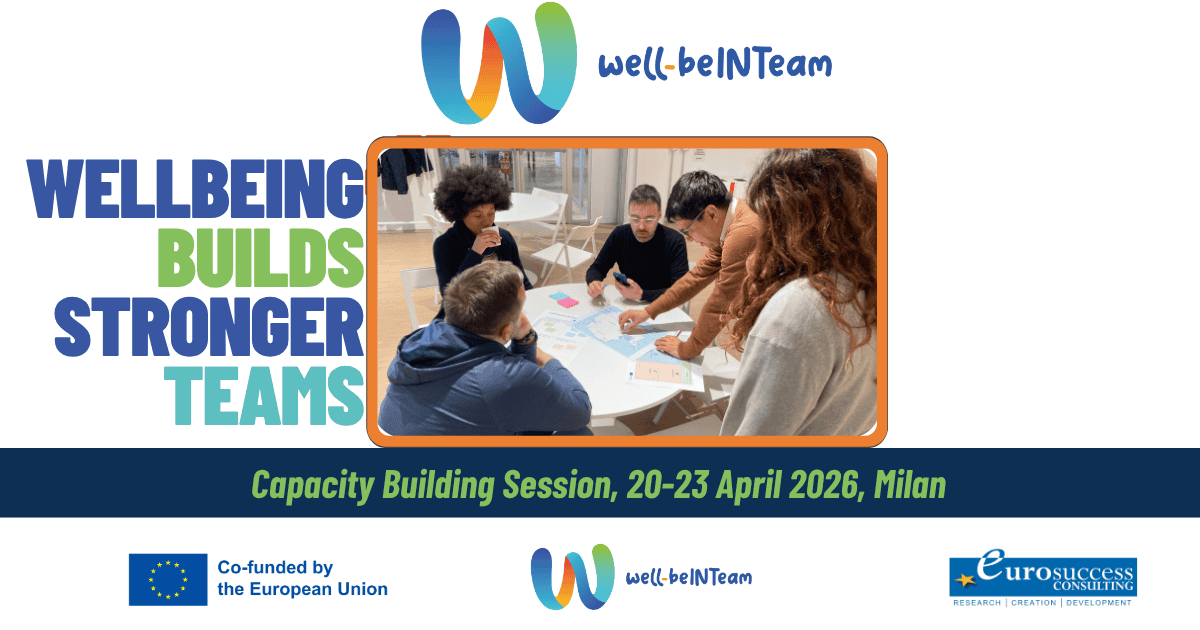
Across Europe, the organisation of work is being reshaped by hybrid teams, digital collaboration and rapidly changing professional environments. For vocational education and training (VET), this creates an important question: how can trainers, consultants and organisations support teams not only to perform, but also to feel safe enough to communicate openly, learn from mistakes and respond collectively to uncertainty? The wellbeINTeam Capacity Building Session (CBS), held in Milan from 20 to 23 April 2026 and hosted by Wyde, addressed this challenge by placing psychological safety at the centre of an experiential learning journey for trainers from the partner countries.
The CBS was not designed as a conventional training event or as a simple presentation of project results. It brought together a four-day programme combining digital tools, train-the-trainer methodologies, analogue role-play and Educational Live Action Role-Play (EDU-LARP). Through this structure, participants explored psychological safety from different but connected perspectives: how it can be measured, how it can be strengthened through training, and how it becomes visible when teams face complexity, pressure and uncertainty.
The first day introduced the main tools and results developed within the project. Partners presented TeamSafe, a tool for measuring psychological safety at individual and team level, PsychoSafe, which examines organisational factors influencing psychological safety, and Hybrid Harmony, a coaching and training platform supporting team development. This practical introduction helped participants understand that psychological safety is not an abstract concept. It can be observed, discussed and translated into targeted learning activities. For VET organisations and SMEs, this is especially relevant, as it supports evidence-based approaches to team wellbeing and performance.
The second day focused on adult learning and the role of trainers in creating effective learning environments. Participants examined concepts such as the learning zone, the Kolb cycle of experiential learning, training macro- and micro-planning, and the 70/20/10 model. These sessions encouraged trainers to move beyond content delivery and consider how learning is structured, facilitated and transferred into professional practice. A key lesson was that training on psychological safety must itself be psychologically safe: participants need space to contribute, test ideas, reflect on their own behaviours and receive constructive feedback.
The most distinctive part of the CBS emerged during the third and fourth days, when the history of Ernest Shackleton’s Transantarctic Expedition became the basis for experiential and game-based learning. Rather than studying leadership and team cohesion through theory alone, participants entered a historical scenario marked by risk, limited resources, disrupted plans and the need for constant adaptation. Through group work, discussion and decision-making tasks, they reflected on recruitment strategies, team rules, conflict management, risk mapping and rescue planning.
The use of Shackleton’s expedition created a powerful analogy for modern teams. Hybrid workplaces may not face the physical dangers of the Antarctic, but they often experience uncertainty, isolation, communication gaps, shifting roles and pressure to make decisions with incomplete information. By working through the expedition scenario, participants were able to recognise how leadership, trust, communication and psychological safety interact when circumstances change. The exercises also showed that psychological safety does not remove structure or responsibility. On the contrary, it allows teams to combine clear direction with honest feedback, shared responsibility and adaptive problem-solving.
On the fourth day, EDU-LARP added a further level of immersion. Participants moved from discussing the scenario to embodying roles, relationships and tensions within a fictional frame inspired by the expedition. This methodology encouraged empathy, perspective-taking and emotional engagement. At the same time, the facilitators introduced safety tools, agreements and debriefing processes, ensuring that the experience remained reflective and respectful. For trainers, this was particularly valuable because it demonstrated how game-based learning can be used responsibly with adult learners, including in professional and organisational contexts.
One of the strongest insights from the CBS was the importance of debriefing. The activities were not valuable simply because they were interactive; their educational impact came from the structured reflection that followed. Debriefing allowed participants to connect the experience with real workplace challenges, including leadership under pressure, open communication, diversity of personalities, short- and long-term priorities, creativity in the absence of resources, and the role of kindness and mutual respect in demanding environments. This process transformed the role-play from a memorable activity into a transferable learning method.
The CBS also highlighted the relevance of psychological safety for the VET sector. Trainers and VET providers frequently support learners and professionals who are preparing for complex labour market transitions. They work with diverse groups, changing technologies and employers who need adaptable teams. By strengthening trainers’ capacity to address psychological safety, the wellbeINTeam project contributes to a broader understanding of employability: one that includes not only technical skills, but also collaboration, resilience, communication and the ability to learn in uncertain contexts.
Importantly, the CBS generated lessons that can be transferred beyond the project partnership. First, psychological safety should be approached as both a measurable organisational condition and a lived team experience. Second, adult learning is more effective when participants are actively involved in problem-solving, reflection and peer exchange. Third, analogue and immersive methods can make complex topics more accessible, provided that they are carefully facilitated and linked to clear learning outcomes. Finally, innovation in VET does not always depend on technology alone; it also depends on creating meaningful learning situations where participants can explore human dynamics in depth.
For Eurosuccess Consulting, participation in the CBS represented an opportunity to strengthen the connection between European project results and practical training for organisations, educators and the labour market. The experience will support the preparation of national pilot activities and the adaptation of the methodology to local needs in Cyprus. It also reinforces the value of European cooperation in developing tools and learning experiences that respond to shared challenges across countries and sectors.
The wellbeINTeam CBS showed that psychological safety is not a “soft” or secondary topic. It is a foundation for learning, innovation and sustainable performance. In VET and organisational settings, where people are increasingly required to collaborate across distance, disciplines and uncertainty, creating safe spaces for dialogue and experimentation is essential. The Milan session offered a concrete example of how this can be achieved: through evidence-based tools, skilled facilitation, experiential learning and reflective practice.
Looking ahead, the value of the CBS will be measured through its application in the pilot phase. Trainers will not simply reproduce activities, but adapt them to the realities of their own organisations and target groups. This adaptation is crucial for sustainability: it ensures that the methodology remains practical, culturally responsive and useful for different VET and SME contexts. In this sense, the Milan CBS created both a common foundation and a flexible pathway for future implementation.
Ultimately, the CBS was more than a capacity building activity. It was a demonstration of how European partnerships can transform project outcomes into practical, engaging and transferable learning experiences. By combining assessment, pedagogy and immersive methodologies, wellbeINTeam offers a promising approach for trainers and organisations seeking to build teams that are not only more effective, but also more resilient, inclusive and prepared for the future of work.
Organisation’s social media channels
Website: https://www.eurosc.eu/en/
LinkedIn: https://cy.linkedin.com/company/eurosuccess-consulting-ltd
Facebook: https://www.facebook.com/eurosuccessconsulting/
Instagram: https://www.instagram.com/eurosuccessconsulting/
Author: Andreas Vasileiadis, Project Manager – Researcher, Eurosuccess Consulting