

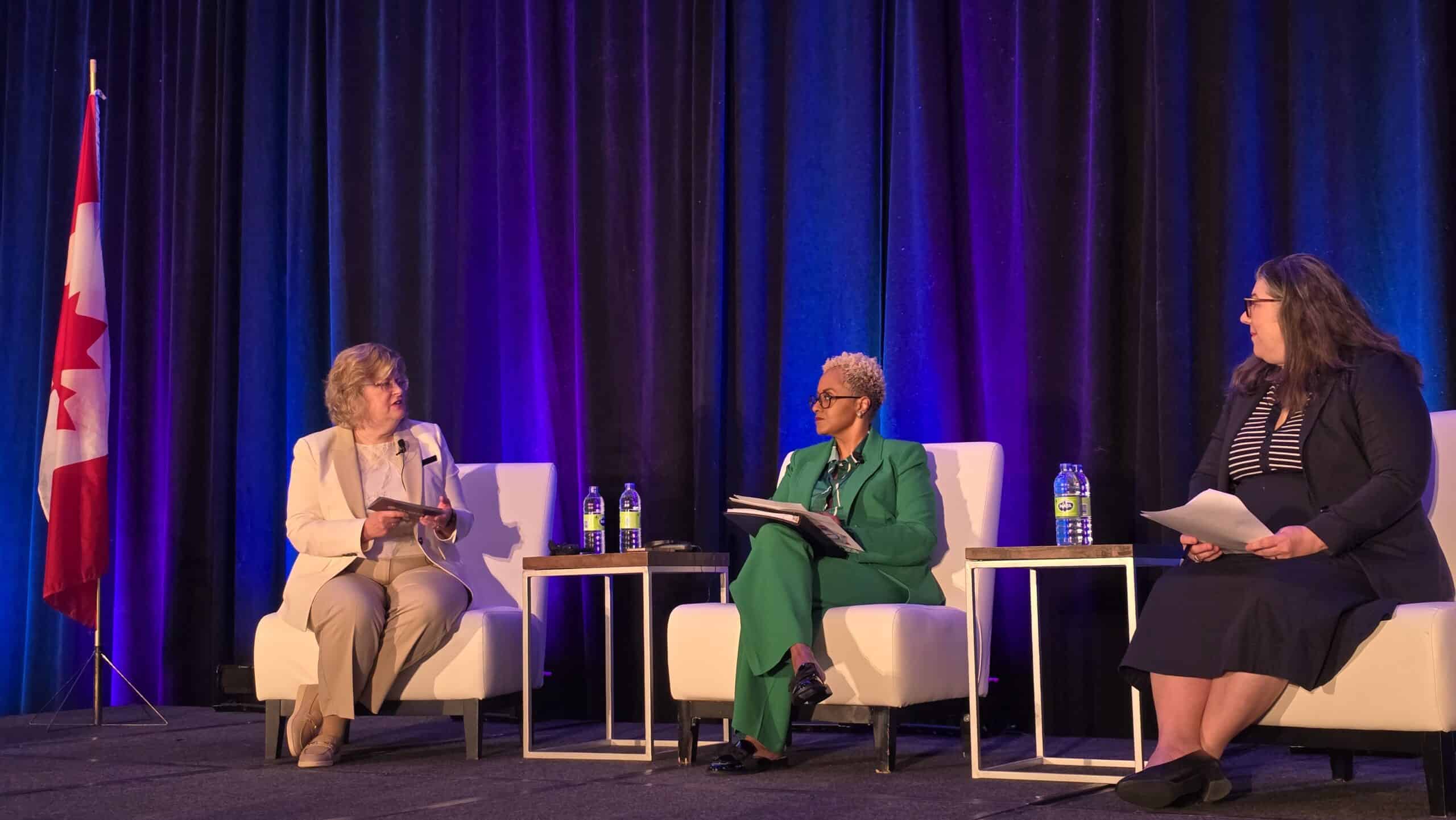
From 21 to 23 April 2026, EfVET participated in the Colleges and Institutes Canada Conference – Building a Strong and Secure Canada – gathering 300+ participants from leaders of Canada’s colleges, institutes, polytechnics, universities of applied sciences to representatives of government bodies, Indigenous associations, employer organisations, training officers, international delegations and education associations.
Representing EfVET, Sylvia Liuti, Vice-President for Projects and Partnerships, and Enrique Blanco, Development & Projects Manager, attended this engaging and interactive event from keynote speeches to parallel sessions across a 3-day programme and facilitated a session titled Global Blueprints for Local Impact: Co-Creating Skills Ecosystems with the CoVE Model.
The session introduced 20+ participants to the European Centres of Vocational Excellence model, highlighting how CoVEs create strong regional skills ecosystems by connecting education, research, business and local development. The session also presented the MOSAIC CoVE project as a concrete example of vocational excellence in action. MOSAIC focuses on arts and crafts, traditional skills, digital learning, internationalisation and cooperation between VET centres and companies. To illustrate the project’s success and cooperation with industry, particular attention was given to the adaptation of the Canadian College and Community Innovation model to Finland through the involvement of Wooden Oy, an SME engaged in the furniture industry.

Overall, the conference offered a rich space for reflection on the common challenges faced by education and training systems across continents. Key discussions addressed recognition, public funding, skills portability, access to learning, inclusion and the role of colleges and institutes in supporting national priorities. The programme also featured high-level contributions, including a keynote by General Jennie Carignan, Canada’s Chief of the Defence Staff, on the role of skills, education and innovation partnerships in strengthening defence readiness, and a keynote by Natan Obed on Inuit communities, post-secondary education and workforce development across Inuit Nunangat.
For EfVET, the conference confirmed the importance of looking beyond borders, encouraging global partnerships in VET. The Canadian experience showed how inclusion must be built through practical, strategic and co-designed approaches, particularly when working with and for Indigenous communities. It also highlighted how VET and skills development can support wider societal goals, from regional innovation to security, resilience, and international cooperation.
EfVET’s contribution demonstrated the strong alignment between the European CoVE model and the work already taking place in Canada at both policy and practitioner level. As new Workforce Alliances are being launched, the exchange with CICan members offered a valuable opportunity to connect European VET priorities with Canadian approaches to applied learning, industry cooperation and community development.
Across Europe, Canada and beyond, VET systems are facing shared challenges that require forward-looking partnerships, practical innovation and a common commitment to equipping people with the skills they need to thrive.