

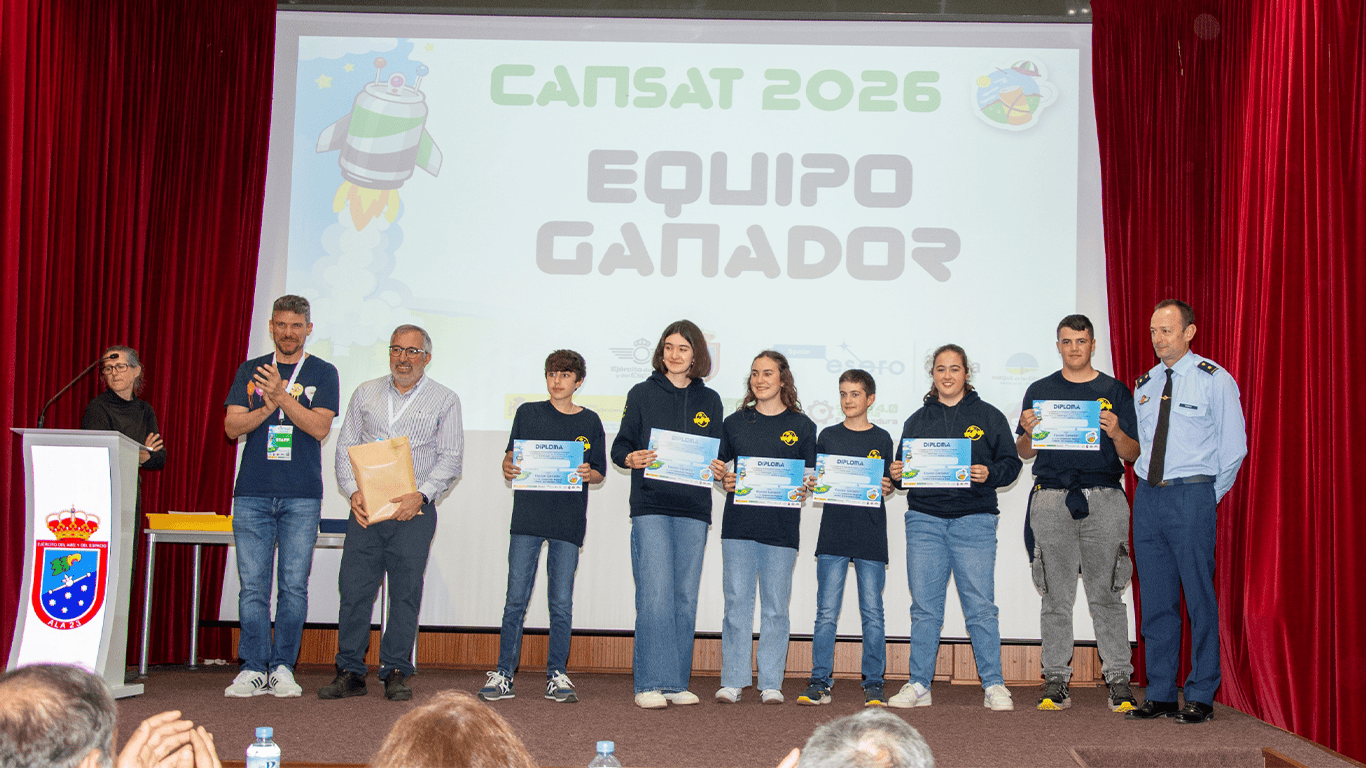
A group of six students from IES Dr. Fernández Santana, a member school of FPEmpresa, has won first prize in the regional stage of CanSat Extremadura with EzeSat, a soft drink can-sized mini-satellite developed as part of the CanSat educational programme.
The initiative, promoted by the European Space Agency (ESA) through ESERO and coordinated in Extremadura by the Regional Government, aims to bring aerospace engineering closer to students through a real hands-on experience. Following this achievement, the team will represent Extremadura at the national stage of CanSat.
The team, made up of secondary and upper secondary education students, spent several months designing, building and validating their CanSat, taking responsibility for areas including programming, electronics, 3D design, communications and data analysis.
The entire system was developed by the team itself. They used an ESP32 microcontroller, environmental sensors to measure temperature and pressure, a LoRa communication system to transmit data in real time, a 3D-designed and printed structure, and a handmade parachute.
An aerospace engineering mission
EzeSat’s primary mission, which was successfully completed, involved measuring and transmitting atmospheric data during the device’s descent. This was complemented by a secondary mission designed by the team, focused on measuring additional variables to provide further scientific value to the project, as well as a third area of work involving the integration of an ultraviolet radiation sensor.
The project followed the stages of a real engineering process, from the initial design to the preparation of technical reports such as the PDR (Preliminary Design Review) and CDR (Critical Design Review). The team also carried out validation tests, structural adjustments and improvements to the fastening systems, wiring and parachute resistance.
Beyond the technical work, the project also stood out for the students’ initiative in organising fundraising activities, including raffles and charity hampers. Numerous local companies also contributed to making EzeSat possible, strengthening the relationship between the school and its local community.
The launch recently took place at Talavera la Real Air Base, where the team put its device to the test and presented its work before the jury. EzeSat was also the first CanSat to be launched from the rocket, marking the beginning of the mission round.
EzeSat has therefore become an example of the potential of project-based learning, demonstrating that science and technology, when approached through motivation and teamwork, can go beyond the classroom and become a transformative experience for students.
Author: The Association of Vocational Training Centres, FPEmpresa, Communications Team (Institutional publication)