
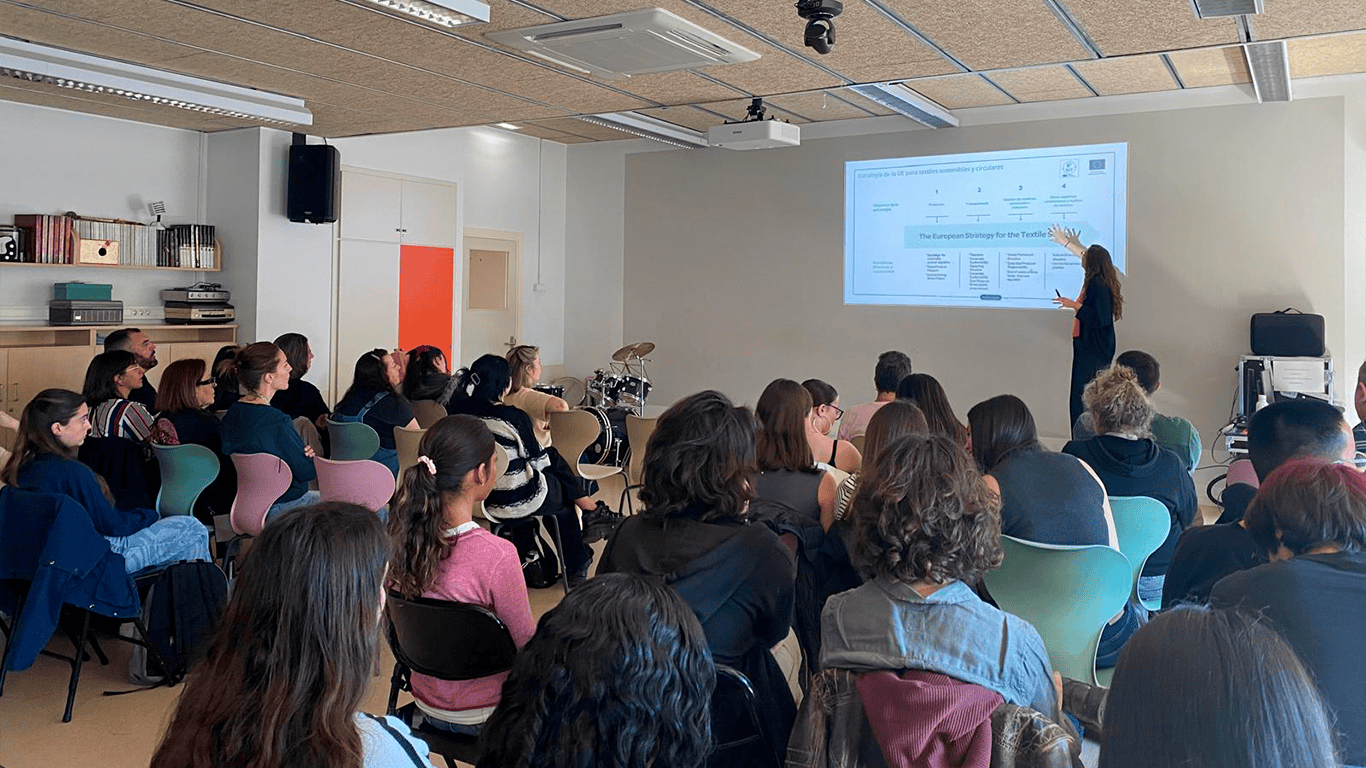
Image from the seminar in Barcelona. Image courtesy of FPEmpresa.
The Association of Vocational Education and Training Centres FPEmpresa has completed in Spain Phase 2 of the Erasmus+ SiT (Sustainability in TCLF) pilot programme, a new stage aimed at transferring the knowledge acquired during the initial online learning phase into real-life contexts.
This second phase has combined specialised training, active methodologies and project development linked to sustainability in the textile sector, consolidating the progress of the programme in Spain.
The SiT project is part of the Erasmus+ Alliances for Innovation programme and brings together partners from different European countries with the aim of promoting new green, digital, functional and transversal skills in the TCLF sectors (textiles, clothing, leather and footwear). In Spain, FPEmpresa leads Work Package 4, focused on the design and development of the training pilot.
Following an initial phase centred on online learning through a specialised MOOC, Phase 2 was developed under the Project-Based Learning (PBL) methodology, encouraging the practical application of knowledge through activities connected to the current challenges of the sector. The programme included three training seminars, one online and two face-to-face sessions held in Madrid and Barcelona, as well as a specific stage devoted to the development of sustainable business plans.
Three seminars connecting training and sustainability
The first session took place on 17 February in an online format under the title Circular Economy in the Textile Sector. It brought together 46 participants, including teachers, students and representatives of associated centres. The lecture, delivered by Paloma G. López, explored the evolution of the circular economy applied to the textile sector, eco-design in fashion and European sustainability regulations, while also presenting real examples of business innovation.
The second event was held on 13 March at IES Leonardo Da Vinci in Madrid and was attended by 103 people. The session, Textile Waste Management with Social and Environmental Impact, was led by Ana Gómez, who analysed the main challenges and opportunities in textile waste management, highlighting the role of the 3Rs (reduce, reuse and recycle) and the importance of the social and solidarity economy as a generator of employment and inclusion.
The phase concluded on 14 April at Institut Anna Gironella de Mundet in Barcelona, also in a hybrid format, with the seminar The Textile Industry and the EU Green Transition: Regulation, Innovation and New Business Models. The event gathered 50 in-person attendees and 25 online participants, and provided an opportunity to explore issues such as the circular economy, eco-design, the new European regulatory framework and the opportunities arising from the sustainable transition.
Overall, the three seminars delivered during Phase 2 attracted a total of 224 participants, reflecting the strong interest generated by this specialised training initiative focused on sustainability in the TCLF sector.
In addition to the specialised training, Phase 2 also included an entrepreneurial dimension through the development of business plans linked to the TCLF sector. A total of seven proposals were submitted, allowing students and participants to work on skills such as creativity, market analysis, innovation, sustainability, problem-solving and business vision, applying the project content to ideas with real growth potential.
With the completion of this stage, the project now moves forward towards new international experiences. Selected participants will take part in a bootcamp in Greece, while the programme will later continue with a Phase 3 focused on Work-Based Learning (WBL), including mobility activities in Italy aimed at company placements and professional shadowing opportunities for teachers.