
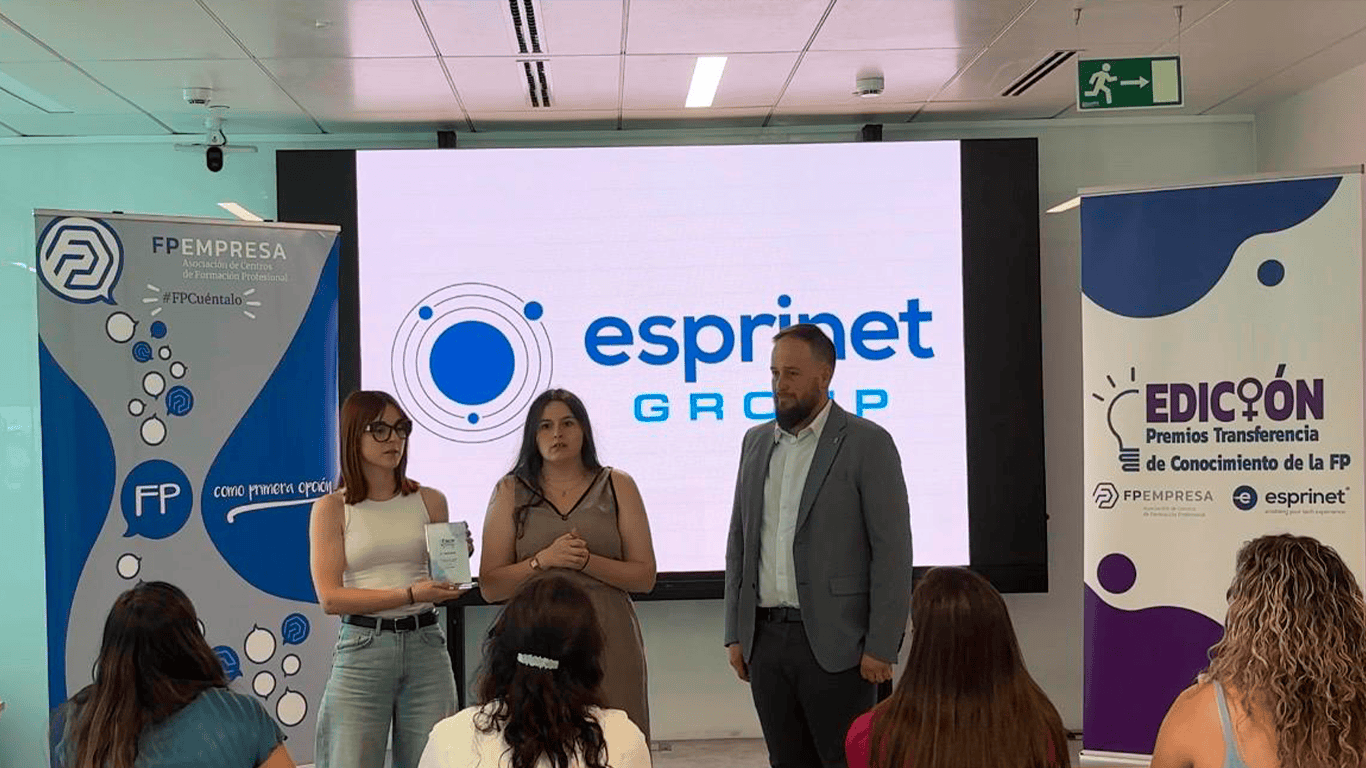
Centro Sagrado Corazón – Jesuitas Logroño has won first prize in the 5th edition of the VET Knowledge Transfer Awards, organised by FPEmpresa and Grupo Esprinet, thanks to the GIRO Project, an initiative that reflects a way of understanding Vocational Education and Training as a space where innovation starts with people and knowledge is placed at the service of society.
Beyond the recognition received, the project highlights a model of VET focused not only on acquiring technical skills, but also on developing professionals capable of identifying real needs, working collaboratively, applying critical thinking and using technology to improve people’s lives.
GIRO was not created as a direct response to a call for proposals or a competition, but rather from a simple yet transformative question: how can engineering help a person regain their quality of life? From this reflection, the students took on the challenge of designing technological solutions with a social impact, demonstrating that innovation reaches its true value when it responds to human needs.
The project was developed by students Itsaso, Laura, Lilu and Verónica, supported by their tutor and Head of the Maintenance and Machining Department, Javier González. However, its scope goes beyond the team itself, as it represents a way of learning in which students are no longer passive recipients of knowledge, but become the driving force behind real projects.
Equality is also built in the workshop
One of the most significant aspects of GIRO has been its ability to encourage reflection on the role of women in industrial VET programmes, professional fields that have traditionally been male-dominated for decades.
The school stresses that equal opportunities are not achieved simply by encouraging more female students to enrol, but also by transforming the role models they encounter when they enter a workshop. With this in mind, the Maintenance and Machining Department has worked in recent years to bring more female talent into its teaching team.
The department currently includes four female teachers and engineers working in technical modules and workshops, providing accessible role models for new generations and helping to break down stereotypes in the industrial sector.
The results are beginning to show. The number of female students enrolled in Mechanical Manufacturing and Installation and Maintenance programmes has progressively increased in recent academic years. In addition, during open days, many families said that discovering projects such as GIRO and seeing female students and teachers leading technological initiatives helped them view these professions as a genuine career option for their daughters.
GIRO is part of an educational strategy that began years ago with projects such as Mecanizado Femenino Plural, developed during the 2023–2024 academic year with the support of CaixaBank Dualiza. All these initiatives share the same objective: to demonstrate that talent, creativity and technical ability are not defined by gender.
The school is also building a new facility entirely dedicated to Vocational Education and Training, designed to meet the challenges of today’s industry and Industry 4.0. The building will include specialised workshops, refurbished classrooms and state-of-the-art technological equipment to further promote active methodologies and innovation projects.
The design also incorporates inclusive facilities, such as dedicated changing rooms for female students and teachers, reflecting the school’s commitment to creating environments prepared for the growing presence of women in industrial professions.
The GIRO Project is far from complete. For the next academic year, the school has submitted GIRO 2.0 to the CaixaBank Dualiza call for proposals. The new project will focus on developing a functional exoskeleton using advanced manufacturing and 3D printing technologies. This next phase will be carried out in collaboration with Sicnova 3D and the Spanish Association Against Cancer.
Through this journey, Centro Sagrado Corazón Jesuitas de Logroño reinforces a vision of Vocational Education and Training based on learning through real-world challenges, purpose-driven innovation, equal opportunities and collaboration with companies, social organisations and professionals. GIRO is not merely an award-winning project, but an expression of a VET model capable of training excellent professionals and people committed to building a fairer, more inclusive and more humane society.
Author: The Association of Vocational Training Centres, FPEmpresa, Communications Team (Institutional publication)