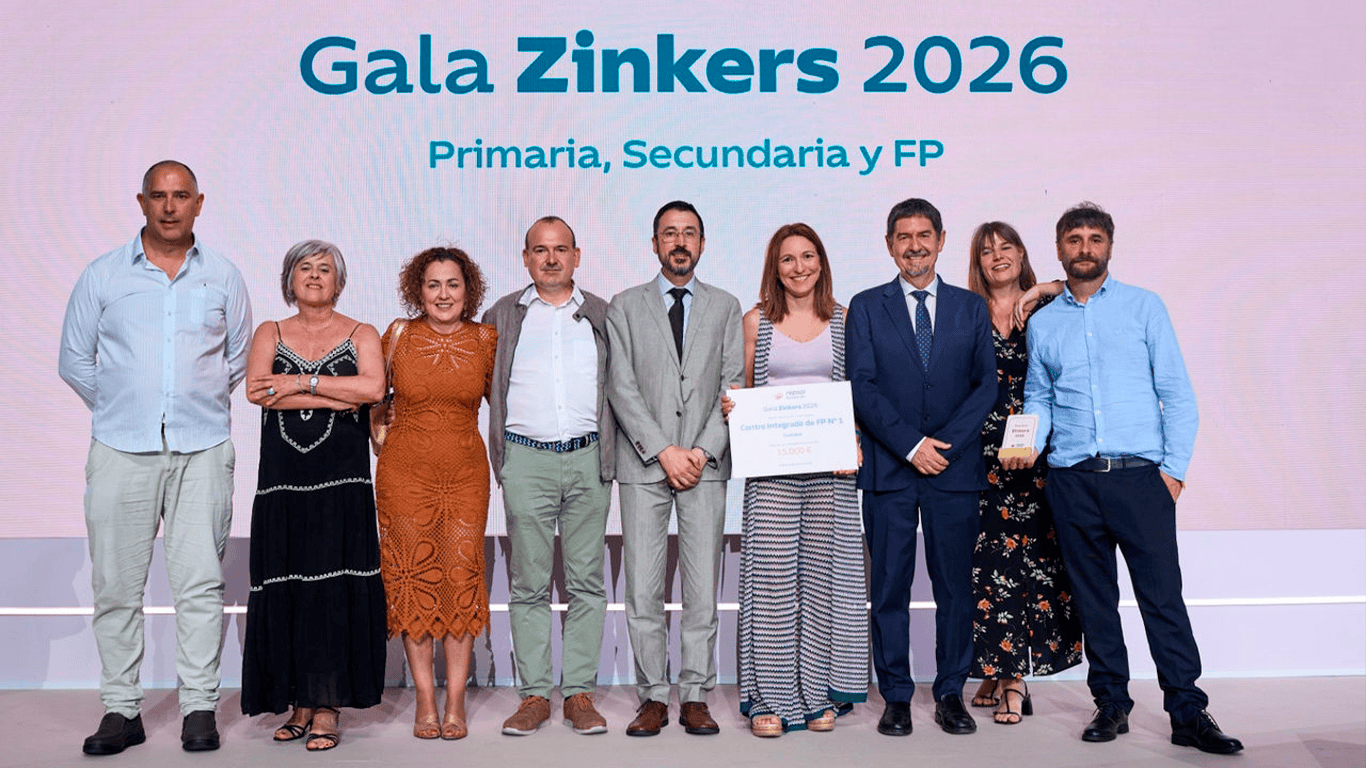
How can an industrial company move towards a more sustainable model without giving up innovation? This question provided the starting point for SOLAREST, an educational project in which students from CIFP N1 de Santander applied the content of the Sustainability Applied to the Productive Sector module to a business scenario. Within the framework of the Zinkers VET Programme promoted by Fundación Repsol, the students developed a Corporate Sustainability Plan for a fictitious company specialising in the design and manufacture of blinds and solar shading systems.
The proposal is based on a clear idea: sustainability should no longer be approached only from a theoretical perspective, but instead become a practical tool for analysing and transforming the way a company operates. To achieve this, the students examined SOLAREST’s context, identified its main stakeholders and analysed environmental, social and governance challenges.
Based on this assessment, the students defined measurable objectives, proposed improvement measures and established indicators to monitor results. The process was developed progressively throughout the academic year, following a structure similar to that of a real corporate sustainability plan and incorporating issues related to innovation and the circular economy.
The result made it possible to approach sustainability from a comprehensive perspective. In addition to addressing its environmental and social dimensions, students also incorporated economic, technological and ethical aspects by preparing objective and indicator tables, ESG analyses, infographics, life-cycle diagrams and a range of improvement proposals.
From the classroom to a blind capable of generating energy
The origins of SOLAREST are directly linked to content previously covered in class. As part of the module, students worked on a learning activity focused on solar photovoltaic energy, analysing how these systems operate and studying components such as panels, inverters, batteries, controllers, wiring and protection devices. The activity concluded with the design of a photovoltaic system for a specific installation, connecting sustainability with electricity, electronics and energy efficiency.
This learning experience later provided the basis for a brainstorming session aimed at imagining how an industrial company could evolve towards a more sustainable model. Among the ideas proposed was the possibility of integrating photovoltaic solar panels into solar shading systems, a concept that eventually shaped the development of a photovoltaic blind.
The Sustainability Plan therefore includes two particularly significant product lines. The first is SOLAREST EcoLine Bamboo, a blind made from renewable materials and designed according to ecodesign and circularity principles. The second is a pilot-stage photovoltaic blind, conceived to integrate renewable energy generation directly into solar shading systems.
For this latter proposal, the students also drew on existing technological references, including a demonstrator developed by Saule Technologies and a flexible organic photovoltaic (OPV) module developed by the Fraunhofer Institute for Solar Energy Systems ISE, linked to the integration of photovoltaic generation into solar shading elements.
A plan built through collaboration
Student participation shaped the entire development of SOLAREST. Following an initial joint phase of analysis and brainstorming, the students organised themselves into small groups, with each team taking responsibility for a specific section of the Sustainability Plan. This allowed them to explore different areas in greater depth while maintaining an overall view of the proposal.
The students took part in decision-making, information gathering, the definition of objectives and measures, and the creation of visual and communication materials. The project thus became a shared learning process in which each participant was able to contribute through their knowledge, interests and technical skills.
This methodology also helped develop transversal skills such as critical thinking, communication, organisation, teamwork, technical creativity, analytical ability and responsibility.
The main impact of SOLAREST is precisely educational. Through the project, students were able to understand sustainability as a professional competence closely linked to their future careers, while also working on content related to electronics, energy efficiency, sensor technology, automation and applied innovation.
Author: The Association of Vocational Training Centres, FPEmpresa, Communications Team (Institutional publication)