
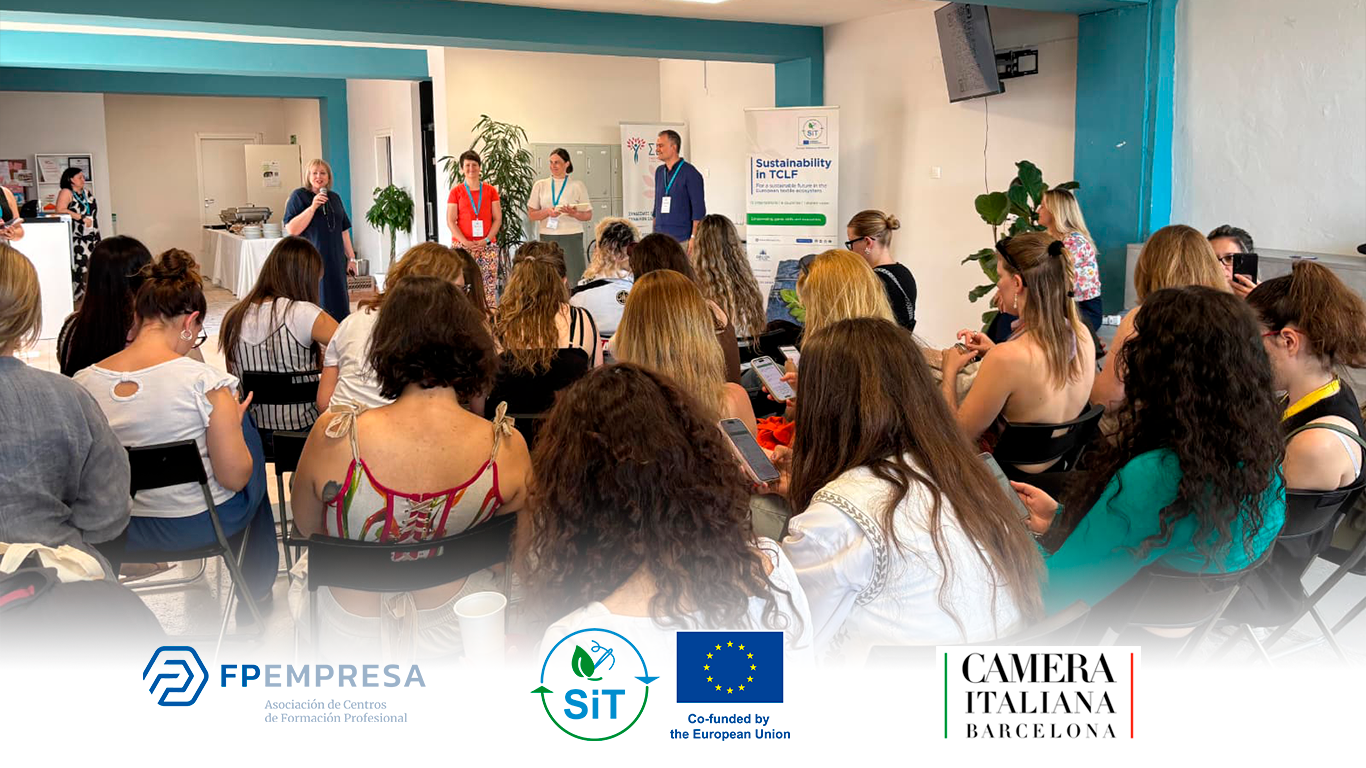
The European SiT – Sustainability in TCLF project held its international bootcamp on 26 and 27 May in Thessaloniki, Greece. This activity marked the closing stage of the pilot programme developed in Spain within the work package led by FPEmpresa and the Italian Chamber of Commerce in Barcelona. The event brought together around 80 participants from the different countries involved in the project partnership, including companies, clusters, associations, Vocational Education and Training teachers, students, entrepreneurs and sector representatives.
The activity took place at WEHub in Thessaloniki, with organisational support from OECON Group, and revolved around three main themes: sustainability, digitalisation and entrepreneurship applied to the TCLF ecosystem, which includes the textile, clothing, leather and footwear sectors. The bootcamp combined collaborative work, idea development, proposal presentations and professional networking spaces among participants.
The first day began with a hybrid session broadcast via streaming, during which the work agenda, the SiT project and the composition of the international teams were presented. The hackathon then began, with five teams working on previously defined case studies through different stages: challenge definition, ideation, solution design, business model development and preparation of the final pitch.
Real challenges to transform the textile sector
During the hackathon, the teams addressed challenges linked to textile circularity and the reduction of environmental impact in different areas of the sector. One of the cases involved designing a circular system for sports kits, with the aim of reducing textile waste while maintaining brand identity, performance and commercial viability.
Another challenge focused on the sustainable management of hotel textiles, proposing solutions to reduce environmental footprint, comply with European regulations on textile waste and move towards models based on reuse, traceability, recycling and material recovery.
After the team work, participants presented their proposals to a jury in a hybrid session. Each team had a limited amount of time to defend its idea, explain the value of the proposed solution and receive the corresponding assessment, in a dynamic aimed at strengthening both entrepreneurial skills and the communication of sustainable projects.
The bootcamp continued on 27 May with a Patchwork Workshop, a practical activity in which participants worked with reused textiles and other available materials, using sewing machines and with the support of expert technicians. In parallel, a professional speed-dating session was held, linked to the fields of textiles, clothing, leather and footwear, with the aim of facilitating mutual knowledge and the creation of new connections among participants.
A winning proposal to respond to the sector’s challenges
The event also included the selection of the winning project, a proposal from Centro Integrado Donibane focused on the circular management of hotel textiles. The team presented a solution aimed at reducing the environmental impact generated by bed linen and other textile waste from the sector, combining the classification and monitoring of garments through artificial intelligence, the reuse and recycling of materials, and the development of a new sustainable fibre with a lower environmental impact.
According to Emilia María García Vera, representative of the winning team, “the project has allowed us to work on a real problem. We are not talking about distant ideas, but about solutions that are already necessary, because European regulations are moving towards models in which everything must be more recyclable and sustainable. For students, it is very important to discover new fibres and new textures, and to understand from the outset where the textile sector is heading.”
With this activity, the SiT project closes the Spanish pilot by strengthening the connection between Vocational Education and Training, companies and real challenges in the TCLF sector. The bootcamp made it possible to transfer the learning developed during the previous phases to an international collaborative working environment, consolidating an experience aimed at promoting more innovative and sustainable VET, closely connected to the green and digital transition.