
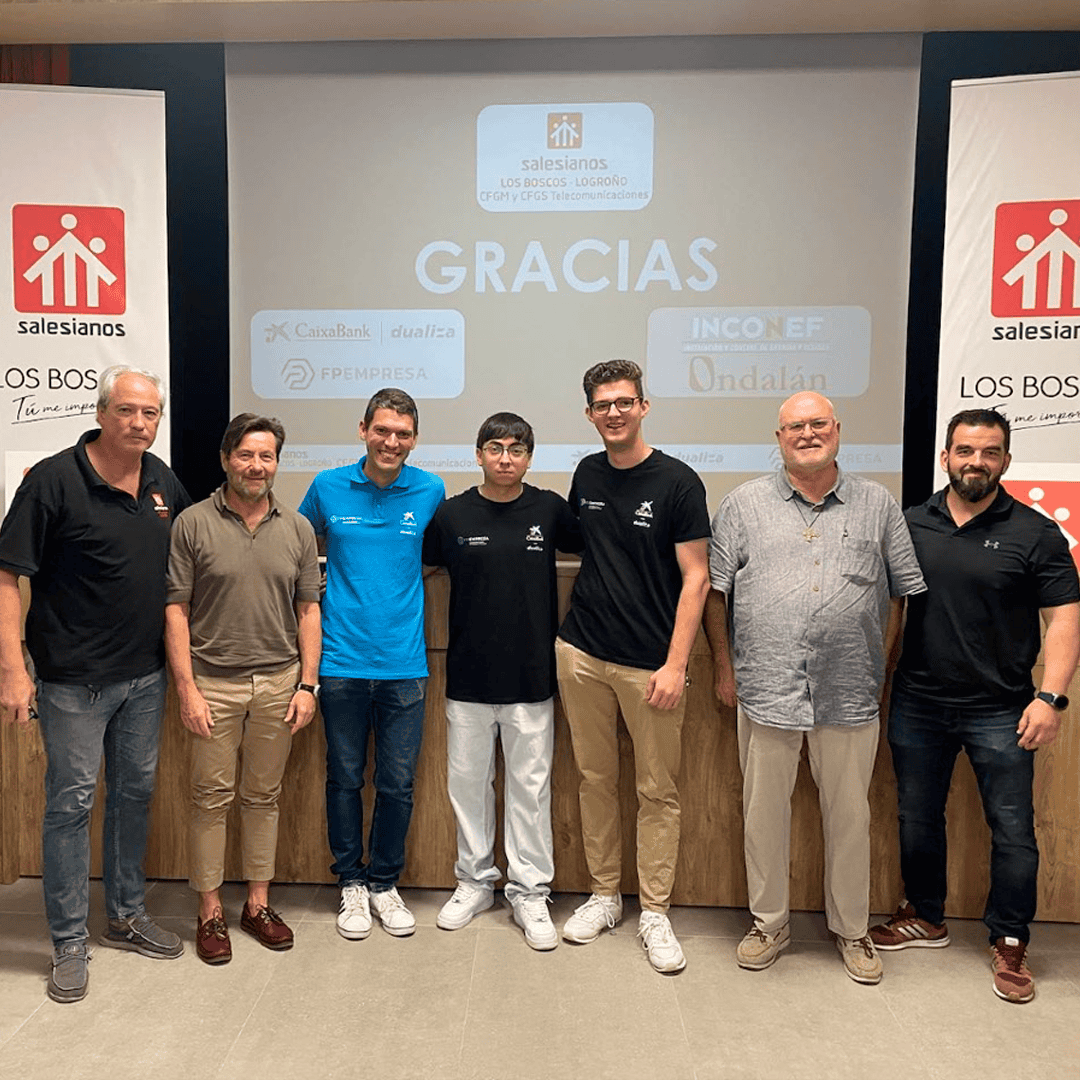
Salesianos Los Boscos has presented the final results of VitiSensor, an innovation project developed by students from Telecommunications vocational training programmes that has enabled the design, construction and implementation of a modular sensor system for smart vineyard monitoring.
The initiative, selected in the 9th Dualiza Grants Call, promoted by CaixaBank Dualiza and FPEmpresa, demonstrates how Vocational Education and Training can generate real technological solutions to address the challenges faced by strategic sectors such as the wine industry.
During the project, students developed an IoT system based on LoRaWAN communications, consisting of a central module and several peripheral modules capable of measuring agroclimatic and physiological variables in the vineyard. The collected information is transmitted in real time to a monitoring platform where the data can be viewed, stored and analysed to support decision-making in crop management.
As a result, the first VitiSensor system has already been installed in a vineyard in La Rioja, and four new agreements have been reached for future implementations, confirming the interest this technology has generated within the agricultural sector.
Open technology at the service of the vineyard
One of the project’s most notable achievements has been the launch of the VitiSensor Site, a web platform created to facilitate knowledge transfer and the replication of the initiative. It provides other educational institutions, teachers, students and professionals with access to all the technical documentation developed during the project.
The site includes information on the components used, electronic schematics, source code, 3D printing designs, IoT platform configuration, examples of data visualisation and teaching materials. In this way, VitiSensor goes beyond the boundaries of the school itself and becomes an open resource for promoting new innovation experiences.
In addition to its technological outcomes, the project has had a significant educational and dissemination impact. A total of 28 students took part directly in its development through Project-Based Learning (PBL) methodologies, working alongside companies and partner organisations in a real innovation environment. Around 150 additional participants were also reached indirectly through the dissemination activities carried out.
Throughout the project, two technical training sessions, six presentation events, workshops and talks were organised, as well as a technical visit to Finca La Grajera, run by the Institute of Grapevine and Wine Sciences (ICVV), and a demonstration session for farmers held at Bodegas Ondalán. More than 50 publications were also produced across media outlets, websites and social media.
During the final presentation, a live demonstration of the system was carried out, showing the complete process from data collection by the sensors to its transmission via LoRaWAN and its visualisation on the platform developed.