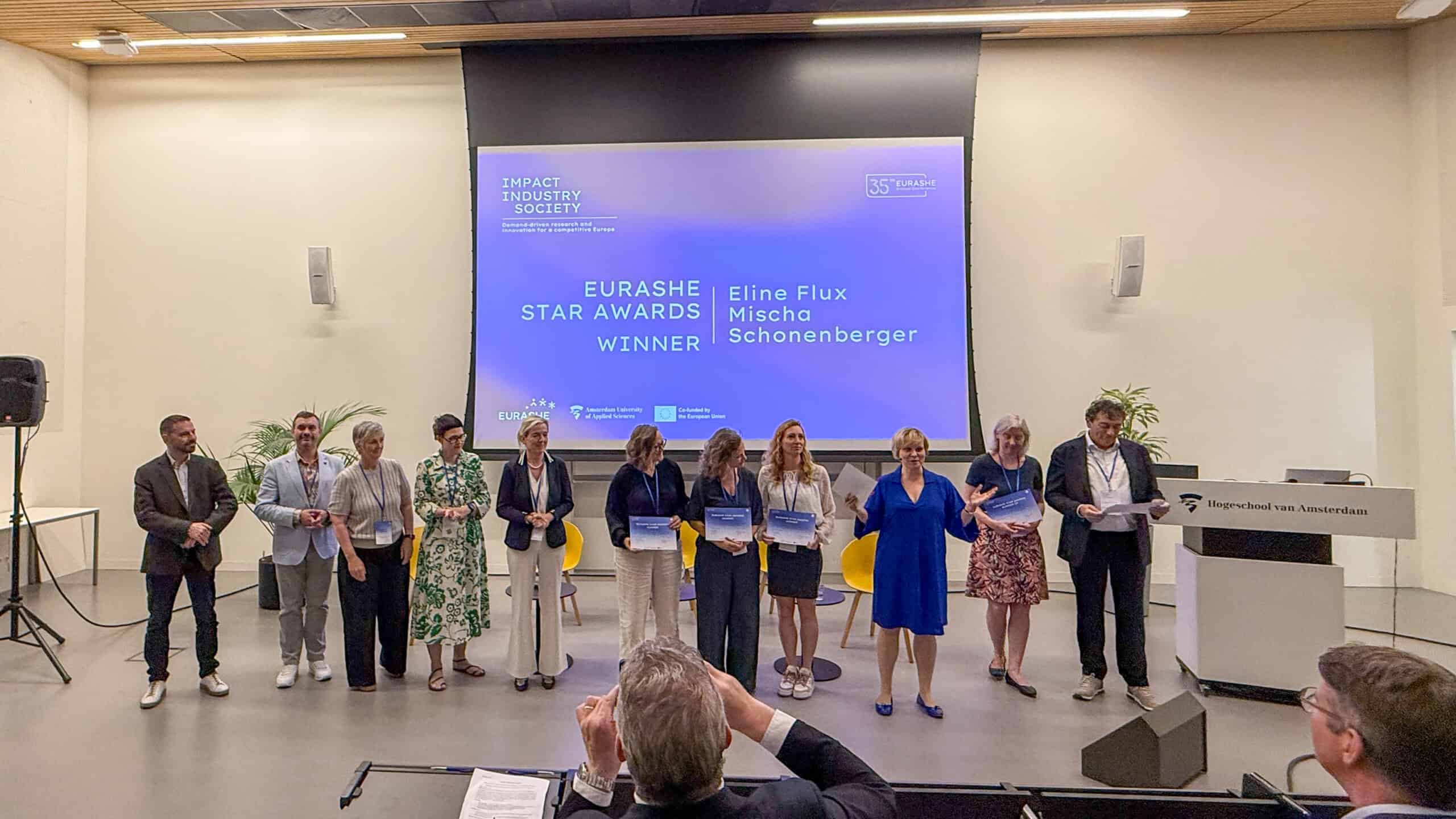
The EURASHE Annual Conference, which was hosted by the Amsterdam University of Applied Sciences on 17–18 June 2026, focused on research and innovation, as well as the impact that universities in the applied sciences generate in the regions and cities in which they are located. The 230 participants were policymakers, academics, university rectors and vice-rectors, students, and practitioners from the applied higher education sector in Europe and beyond.
The 35th Annual Conference was opened by EURASHE President and CEO Hannes Raffaseder. He emphasised that universities of applied sciences must serve both major cities and rural regions alike, highlighting this as one of the defining strengths of the sector — its unique ability to connect regions, cities and member states across Europe. In a world facing rapid technological change and complex global challenges, he stressed that research is more essential than ever — not only fundamental, curiosity-driven research, but also the work needed to bridge the gap between fundamental research and market-oriented innovation. He explained that this was precisely where universities of applied sciences played their vital role, connecting research with industry and academia with the world of work. He concluded by issuing a sobering reminder that society’s trust in science has been on the decline, making the reconnection of research with society more urgent than ever.
Geleyn Meijer, EU Affairs Representative, Amsterdam UAS welcomed delegates from across Europe to the conference of the European Association for Applied Science and Higher Education in his open remark. Geleyn Meijer in his welcome speech he empaziphed the vital role of vocational and applied education in shaping Amsterdam’s past, present, and future. From medieval craftspeople to today’s tech specialists, skilled professionals have always been the backbone of the city. He highlighted three exciting initiatives — the Neighbourhood Compass, the Bright Minds Academy, and a creative communication project — as examples of how practical education is tackling real urban challenges in areas like housing, healthcare, and employment. Amsterdam University looks forward to exchanging ideas and best practices with its European partners to strengthen education and research across the continent.
Sofyan Mbarki, Alderman, City of Amsterdam, delivered a heartfelt tribute to the vital role of vocational education in the city’s daily life. Sofyan Mbarki stressed that Amsterdam’s essential services — from media and healthcare to technology, hospitality, safety, and construction — are kept running by students, declaring that without them, “Amsterdam is at a standstill.” His words served as a powerful reminder that the city’s resilience and functioning depend not only on academic research and innovation, but equally on the practical, hands-on skills of vocationally trained professionals working across every corner of urban life.
European Commissioner Ekaterina Zaharieva delivered a video message to the conference, emphasising the critical role of applied sciences in Europe’s competitiveness. Ms Zaharieva praised EURASHE’s representation of over 500 higher education institutions across Europe, recognising universities of applied sciences as key to building bridges between academia, industry, policy and practice. She emphasised that Europe’s competitiveness hinges on two key priorities: investing in individuals capable of applying knowledge and fostering stronger collaboration across sectors and regions. Ms Zaharieva highlighted initiatives such as ‘Science Comes to Town’ as powerful examples of bringing innovation closer to citizens, with Amsterdam leading by example in integrating research and innovation into its city strategy. Ms Zaharieva concluded with a clear call to action, saying that we must continue to build bridges across sectors, regions and borders because Europe thrives through innovation that delivers real impact.
Robert Dijkgraaf, Professor for Science and Society, University of Amsterdam, former Minister of Education, Culture & Science in the Netherlands delivered an inspiring and thought-provoking presentation on the future of research and innovation in Europe. Robert Dijkgraaf stressed that Europe’s greatest strength lies in its diversity of ideas and pluralism — not as obstacles, but as drivers of innovation — and its open, collaborative values. However, he also warned that knowledge itself is under pressure, with shrinking academic freedom and misinformation campaigns undermining public trust in science. He called for smarter alignment of national research policies, greater inclusion of universities of applied sciences in European decision-making and a shift away from siloed, hierarchical education systems towards more connected, transdisciplinary approaches. He also stressed that universities of applied sciences play a unique and vital role as bridge builders between knowledge and society, and between research and real-world impact. Finally, he concluded on an optimistic note, reminding the audience that education remains the most reliable source of hope for the future.
The first panel discussion brought together four distinguished speakers to explore the role of universities of applied sciences in Europe’s competitiveness.
Ellen Hazelkorn of Technological University Dublin offered a sharp international perspective, noting that governments are increasingly recognising the need for a more strategically diverse tertiary education system. She argued that universities of applied sciences have a distinct role to play in solving real-world problems through translational and challenge-based research. She emphasised that ‘it’s not what you know, it’s what you do with what you know’. She also called on institutions to be ‘loud and proud’ about their unique contributions and stressed that innovation is not just about products and services, but also about social change and transformation.
EU Affairs Representative of the Amsterdam University of Applied Sciences, Geleyn Meijer, shared how the university puts collaboration into practice. He highlighted the university’s strong tradition of co-creating curricula with external partners, its network of over 40 active project locations across the region and its innovative ‘showroom’ model, which brings together all disciplines around key societal challenges. He also emphasised the importance of agenda-setting and making strategic choices, including knowing when to refer a challenge to another institution, as a sign of institutional maturity.
Martijn Schut of Facta brought an industry perspective to the discussion, emphasising the urgent need for practical skills and faster collaboration between companies and universities. Stressing that Europe is full of ideas but struggles with implementation, particularly for SMEs, Mr Schut called for easier, more accessible pathways for companies to connect with universities when they need solutions quickly.
Robert Dijkgraaf of the University of Amsterdam reinforced the themes of the panel, drawing on his experience as a scientist and a former minister. He called for greater equity across the education system and the removal of unnecessary legal and institutional barriers between different types of education. Dijkgraaf also called for a new tertiary education system to be created that is fit for the 21st century. He also emphasised the importance of ‘orchestrators’ — individuals with one foot in academia and one in industry — as vital connectors within institutions, urging universities to recognise and support these roles.
In conclusion, the panel unanimously agreed that universities of applied sciences need to embrace their unique position as bridge builders, connecting knowledge with society, research with practice and institutions with industry. They have the greatest opportunity to strengthen their research role, deepen collaboration across all sectors and act as orchestrators in an increasingly complex world. As Robert Dijkgraaf powerfully reminded the audience, education remains our most reliable source of optimism, and universities of applied sciences are at the heart of that promise.
The breakout sessions gave delegates the chance to explore specific challenges and innovations in applied sciences in more depth. These sessions provided valuable opportunities for peer exchange, offering practical insights and fresh thinking on the evolving role of applied research and education.
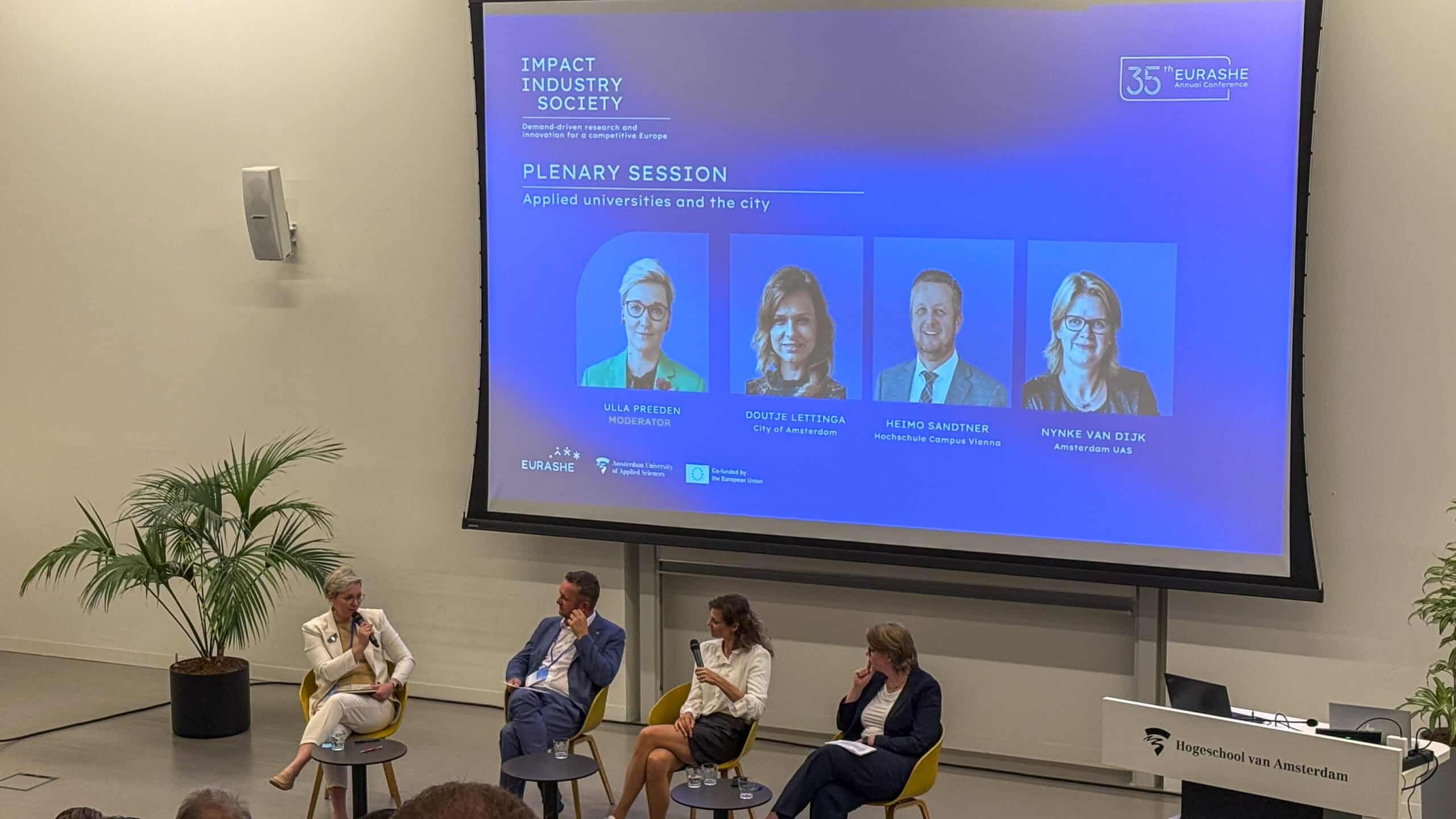
In the afternoon, the second plenary session brought together three inspiring speakers to discuss how universities of applied sciences can strengthen their collaboration with cities and urban communities.
The three speakers painted a compelling picture of a future in which universities, cities and communities work together as equals, sharing agendas, pooling resources and solving real-world problem together. Doutje Lettinga, Heimo Sandtner and Ninke van Dijk are focusing on city-university partnerships and will share how Amsterdam and Vienna collaborate with applied universities to solve real urban challenges through open knowledge sharing and long-term strategic agendas.
The third panel discussion focused on excellence in applied Excel, moderated by Jon Altuna, EURASHE Vice-President. Pascal Krupla from HCT in Dubai introduced the framework to the audience, explaining its origins and purpose. He described how eleven universities came together to develop a seven-dimensional framework specifically tailored to applied universities, addressing a long-standing gap: while traditional universities have international frameworks for measuring excellence, universities of applied sciences have not. He emphasised that the tool is not about ranking or competition, but about benchmarking, self-assessment and sharing best practice. The ultimate goal is to create a common language, support institutional improvement and give universities of applied sciences the recognition they deserve. Alna Kin-Tak Lan, president of a technological higher education institute in Hong Kong, welcomed the framework enthusiastically. He stressed that traditional university rankings are simply not designed for applied institutions, whose mission is to serve industry needs and support local economies rather than excel in fundamental research. Lan shared how her institution had transformed its employability rate from 67% to 92% by co-designing programmes with industry. She argued that this kind of impact deserves its own measure of excellence. Lan concluded that the framework is valuable precisely because it enables institutions to learn from each other without becoming embroiled in a ranking competition that does not reflect their true purpose. Karin Verschoor, a board member at Saxion University of Applied Sciences in the Netherlands, reflected on what the framework adds to existing mandatory accreditation processes. She noted that mandatory accreditation only measures baseline requirements, whereas this new tool reveals the full quality and depth of what universities of applied sciences actually do. Ms Verschoor also highlighted that the framework provides institutions with a shared foundation and a common language with which to articulate their value to students, to the world and to each other. She also expressed hope that more universities would participate in the assessment process, as more data would enable more meaningful comparisons and improvements. Grant van Shaik of SAIT in Canada echoed these sentiments from a North American perspective. He explained that, for his institution, the framework’s greatest value lay in its focus on continuous improvement, allowing the university to take a holistic view of how all its systems work together, from strategy and industry engagement to curriculum development. He also highlighted the peer learning aspect as being particularly valuable, as it provides a structured opportunity to have honest conversations with other applied institutions and identify best practices across borders. He stressed that, ultimately, everything the institution does comes back to one anchor: becoming a better institution for its students.
Iuri Aganetto, a project officer at UNESCO brought a vital global perspective to the discussion. He linked the framework to UNESCO’s broader efforts to transform higher education in Africa. Over the course of four years, his team collaborated with twelve universities to address challenges relating to applied research, mobility and higher technical education. He noted that the lessons learned from that project closely mirrored the aims of this benchmarking tool. He also referenced UNESCO’s recently published 2026 roadmap for transforming higher education, which includes a dedicated pillar on recognising different forms of excellence — a vision that strongly resonates with the goals of this new framework. Together, these five voices from across the globe delivered a clear and united message: the time has come to define excellence in applied education on its own terms, rather than through rankings. This should be achieved through shared learning, honest self-assessment and a common language that reflects the true, indispensable value of universities of applied sciences in society. In conclusion, this session made one thing unmistakably clear: universities of applied sciences around the world share the same strengths, challenges and ambitions. From Hong Kong to Canada and from the Netherlands to South Africa, these institutions are stepping up to serve their communities, drive innovation and bridge the gap between knowledge and real-world impact. This new benchmarking framework provides them with a powerful common language with which to celebrate their successes, learn from each other, and claim the recognition they have long deserved. The future of applied education is global, collaborative and full of promise.
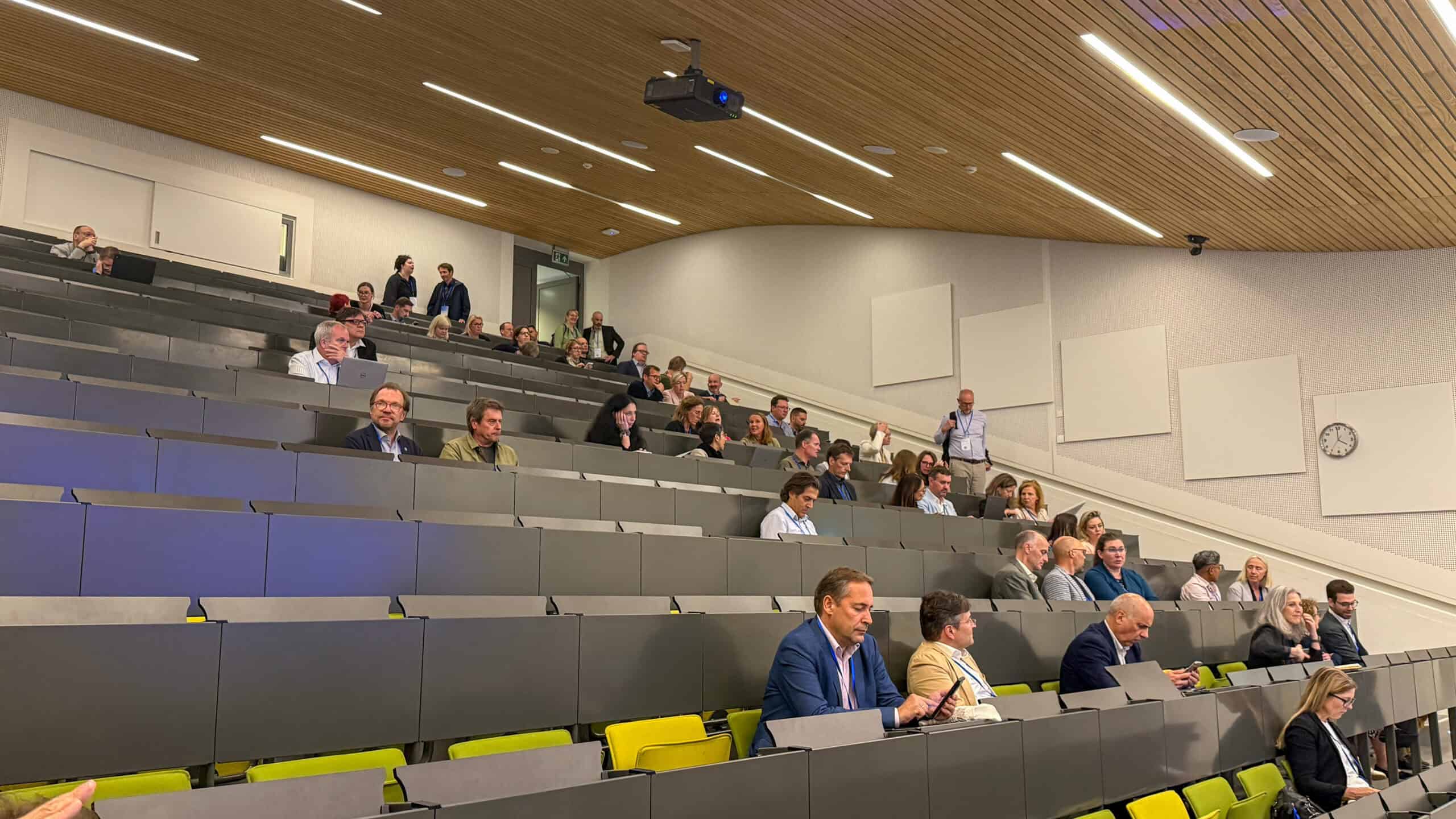
On the second day of the conference, the focus moved towards lifelong learning. The day began with a presentation of key findings from national-level interviews, offering valuable insight into the way institutional practices are evolving across Europe. Frank van der Zwan-Scholtz began his presentation by discussing how Dutch universities of applied sciences (UASs) are piloting a new ‘Professional Doctorate’ (PD), which is different but equivalent to the traditional PhD. This initiative addresses a long-standing issue: until now, only comprehensive universities have been able to awarded doctorates in the Netherlands.
During the panel discussions, panellists from EURASHE member institutions discussed various topics, including internationalisation, quality assurance, and qualifications. This illustrated how the Dutch higher education ecosystem works in practice.
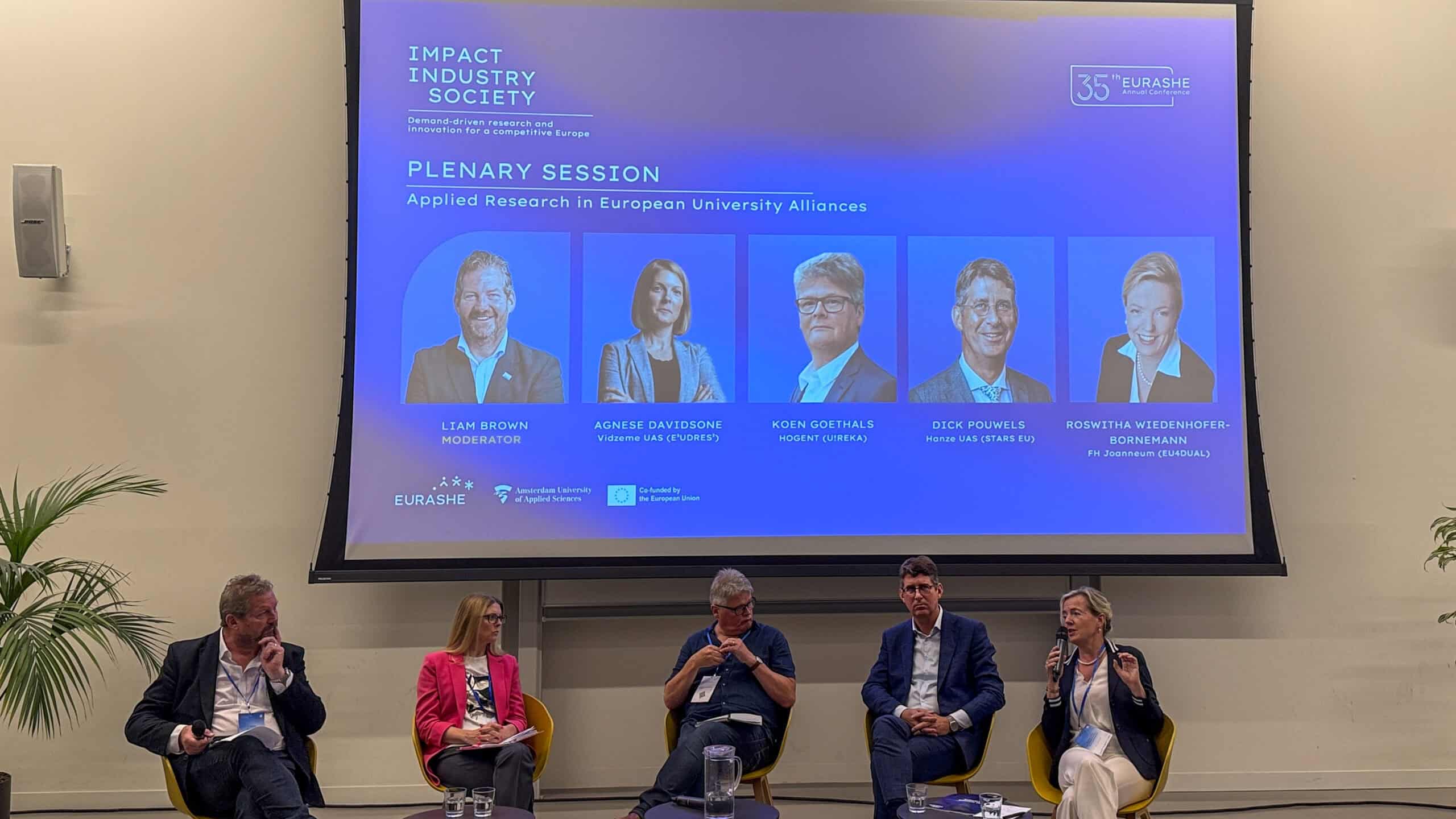
Agnese Davidsone, from Vidzeme (E’UDRES’), described how her alliance has matured from a pilot project to a living lab. She highlighted the importance of open communication and a practical, finish-what-you-start approach. However, she also noted that her institution’s ambitions often exceed its capacity. Koen Goethals of Hogent (U!REKA) argued that alliance membership has increased the number and quality of successful research proposals, helped by internal policy changes that reward international collaboration. He also highlighted a deeper shift: growing recognition and pride among universities of applied sciences. This is evidenced by the fact that Flanders has recently allowed such institutions to officially call themselves ‘universities of applied sciences and arts’. He also called for the redefinition of ‘excellence’, arguing that publication counts alone misrepresent the impact of applied institutions. Representing Hanze UAS (STARS EU), Dick Pouwels focused on the alliance’s commitment to regional, non-capital-city development. This commitment is realised through the combination of education and research via living labs and a ‘regional transition accelerator’ that works directly with industry and government partners. Roswitha Wiedenhofer-Bornemann from FH Joanneum (EU4Dual) highlighted dual higher education as the defining feature of the alliance, highlighting a new European scientific journal dedicated to dual higher education, three shared research challenge areas and an ambitious joint doctoral programme that combines academic and industrial PhD models and is scheduled to launch in 2028. She also highlighted PPP-style funding models, such as Austria’s regulatory sandboxes and the Christian Doppler research laboratories, as effective mechanisms for translating research into practice.
In his closing remarks, Simon Pickard of Science Business summarised two days of debate in three words: collaboration, practice and differentiation. He urged applied universities to embrace their niche, engage boldly with EU policy and position themselves as living laboratories for Europe’s future talent. During the closed discussion, Simon called for greater international engagement, recalling the original global ambition of Erasmus Mundus.
Two days, many voices, one clear direction. The message that EfVET took away from the EURASHE conference is that applied universities are no longer waiting to be recognised. They are stepping forward, defining their own terms and making their case with confidence and a call to action. We need to speak up about what we do. To engage more boldly in European policy discussions. To build partnerships that go beyond our comfort zones.